

By any standards 1956 was a remarkable year for cricket. Overcoming a chilly and damp summer, Surrey made history by becoming the first to win five County Championship titles in succession while England beat Australia 2-1 to retain the Ashes, their third successive series victory. At the centre of it all was Jim Laker. Richard Spiller looks back 70 years…
Laker’s year
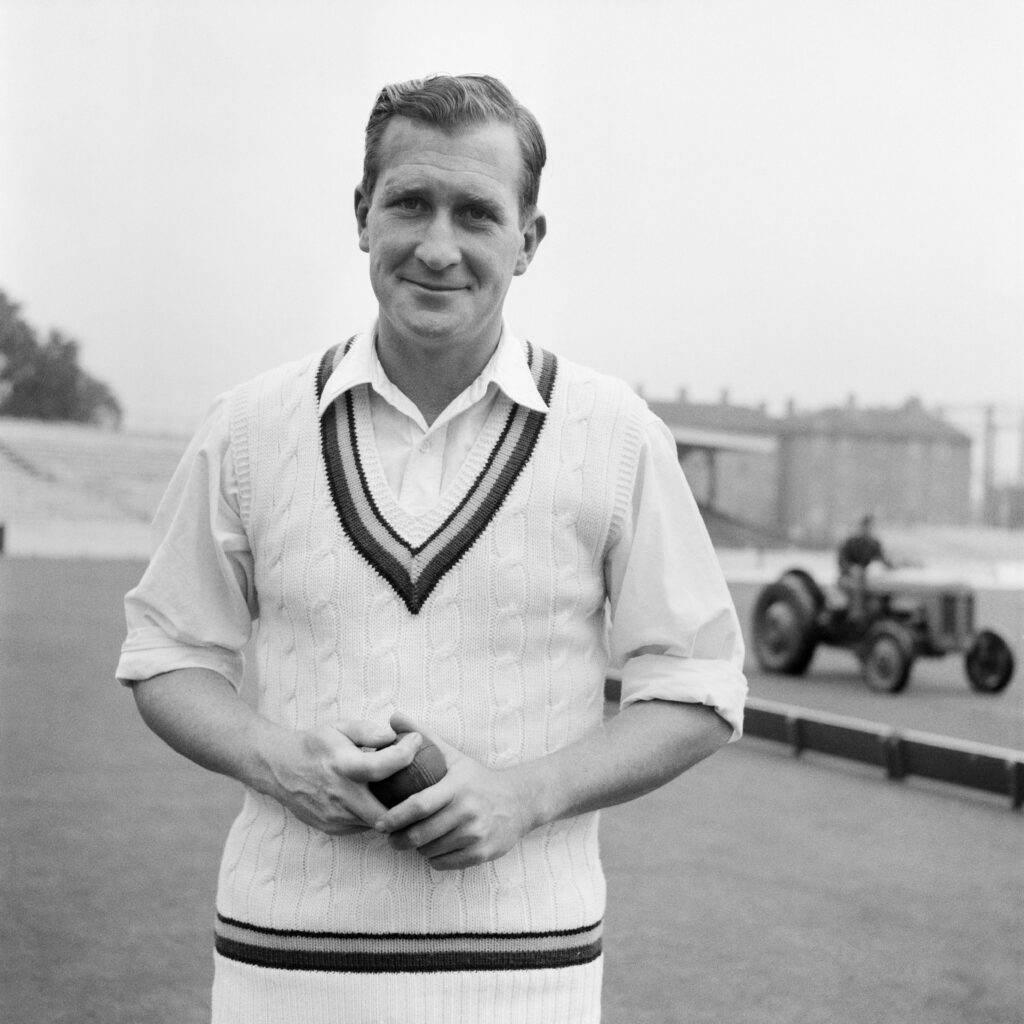
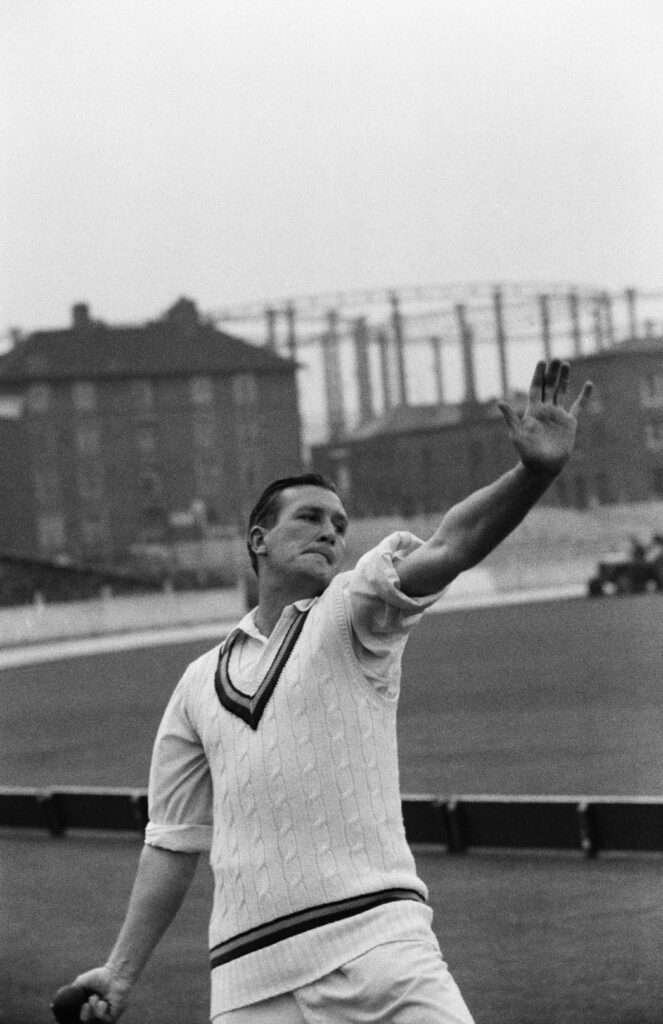
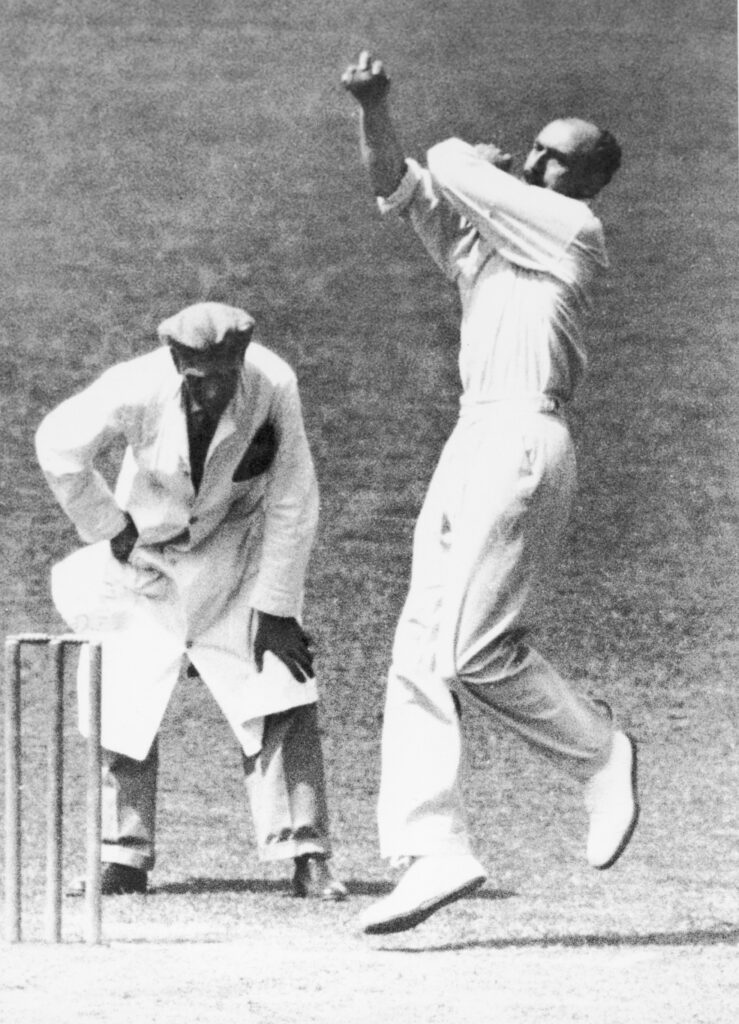
Heading into the 1956 season, Jim Laker had established himself among the finest off-spinners in the world. Yet England’s selectors still weren’t sure and since his debut in 1947 he had played just 24 Tests. Strength of competition and doubts about his temperament remained. He had been ignored for two successive Ashes tours and in 1955 played just one of the five Tests against South Africa.
By the end of the summer, all such doubts had evaporated. Laker’s 46 wickets in five Tests included his devastating world record 19-90 at Old Trafford, taking 9-37 in the first innings and 10-53 in the second. On a pitch which had Australians muttering about sharp practice – but which was good enough for England to make 459 after winning the toss – they were bowled out for 84 and 205, even though almost all the third day and most of the fourth had been lost to weather. Laker’s total command of his art in the conditions saw Australia unable to provide answers, keeping the fielders in the “leg trap” in constant business.
Laker had already established a mastery over the tourists when they took on Surrey in mid-May, taking all 10 wickets (for 88) in the first innings. It was instrumental in his county becoming the first to beat an Australian touring team for 44 years. In the process, Laker became the first bowler to take all 10 since Edward Barratt (also of Surrey) against an Australian side since 1888. He was presented with the match ball and a cheque for £50 from the Surrey committee.
His spin partner Tony Lock had finished with 0-100 in the first innings – and would take the other wicket to fall at Old Trafford later in the summer – while Australian skipper Ian Johnson presented counterpart Stuart Surridge with his cap. Overall, Laker would claim 143 first-class wickets at 14 during the season, his haul in Tests costing just nine apiece.
No one was questioning who was the best off-spinner now and just before Christmas, he was named as the BBC’s Sports Personality of the Year.
Surrey’s year
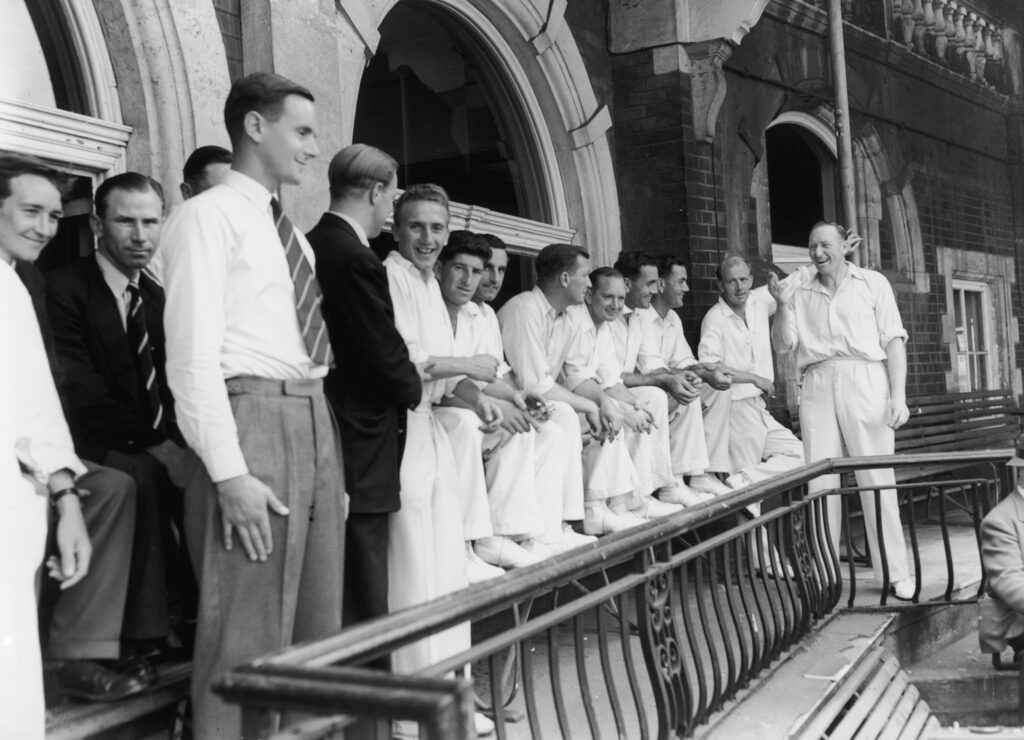
Stuart Surridge had confidently predicted that Surrey would win five successive County Championship titles when he assumed the captaincy in 1952 and proved as good as his word.
They had been irresistible the previous summer, establishing a record number of points (284) and all 28 matches being played to a conclusion with 23 wins and five defeats, finishing 16 points ahead of Yorkshire.
This time they could only muster 200 but the vile weather contributed, rain ensuring eight matches were drawn, yet nearest challengers Lancashire were 20 points adrift.
It took Surrey a while to hit their stride, winning just three of their first seven outings and losing three others, only going top for the first time in early July and seeing the Red Rose county recapture the summit for much of that month.
But a spurt in early August, overcoming Essex, Middlesex both home and away and Sussex took them clear so that a rain-strewn finish which prevented any of the final six matches being decided mattered not.
Surridge had always been happiest leading in the field and his final season before handing over to Peter May underlined that. Surrey only passed 300 on six occasions and were indebted to Tom Clark’s return from hip trouble to make 1,325 runs for leading the run scorers. Micky Stewart (1,187), May – making 1007 when available from international duties – and Ken Barrington (1,051) were the others to reach four-figures.
It was the bowlers who proved so devastating, led by Lock. He might have taken second billing to his spin partner against Australia but 117 wickets at 10 apiece underlined how effective he could be, not least against Kent at Blackheath. Surrey’s 404-4dec, built around Clark’s 191, set the stage for the left-armer to rip through the hosts with 6-29 in the first innings and then 10-54 in the second.
Paceman Peter Loader (102 at 15) was second, Eric Bedser underlining his often understated talent with 68 at 17, ahead of fellow off-spinner Laker (57 at 18), while Alec Bedser – whose England days were now behind him – remained a huge threat as he took 83 at 18.
Surridge handed over his team of champions to Peter May, who would lead them to two more titles.
Oval Test
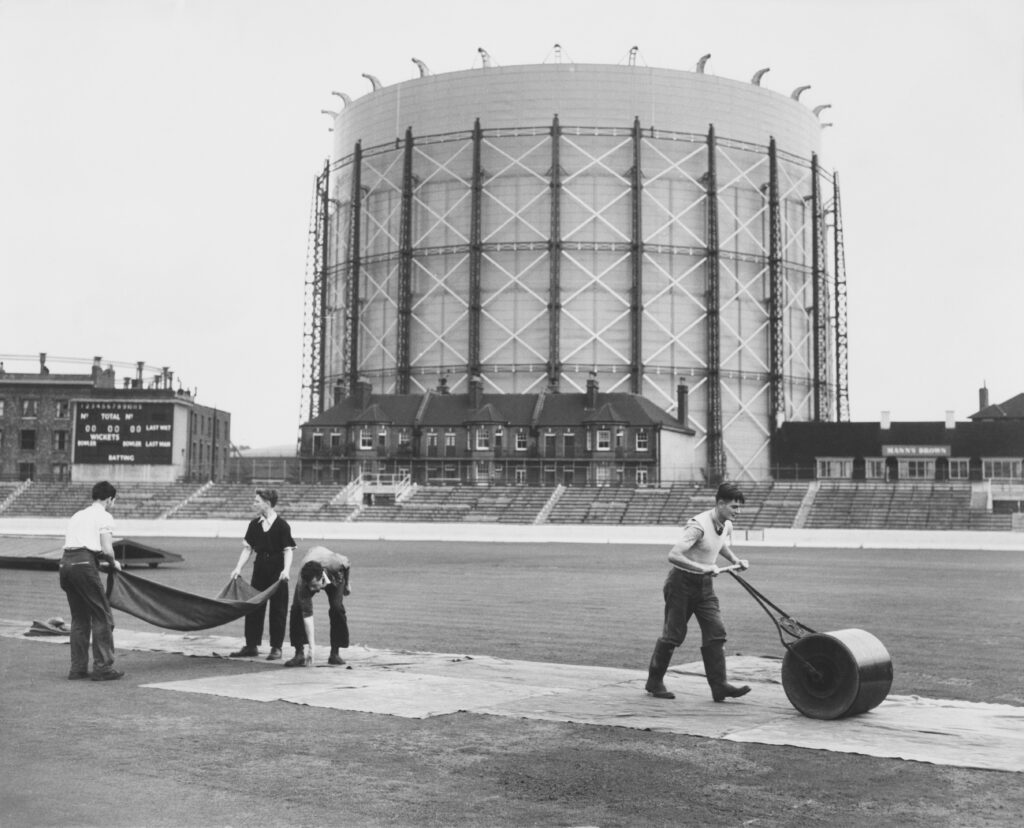
England arrived at The Oval with the Ashes – won back in 1953 and retained 18 months later down under – secured but the series still undecided at 2-1.
The hosts had started favourites, unable to take advantage of being well placed in the opening match at Trent Bridge by 12 hours and 20 minutes lost to rain but then suffering a 185-run defeat at Lord’s as Keith Miller – now 38 – rolled back the years by taking 10 wickets.
England’s selectors were accused of panic when they recalled one of their own number, 41-year-old Cyril Washbrook, for the first time since 1950-51 at Headingley. But entering in another crisis at 17-3, his heroic 98 helped skipper Peter May (101) to add a match – and series – transforming 187. England’s 325 all out setting up a victory by an innings and 42 runs as Laker claimed 11 wickets.
With Len Hutton now retired and Denis Compton still recovering from the loss of a kneecap, England remained too dependent on May, the outstanding bat in the series in averaging 90. Australia still had the ageing Miller and Ray Lindwall, plus Ron Archer – whose career would soon be cut short by a knee injury – and promising Alan Davidson. Richie Benaud’s leg-spin complemented that pack but they depended on skipper Ian for finger-spin and their batting struggled throughout.
Another surprise recall came across the Pennines when David Sheppard, who had played only four innings that season after concentrating on ecclesiastical duties, was brought back and made 113, which together with opening pair Peter Richardson (104) and Colin Cowdrey (80) gave Laker plenty more runs to bowl out in his historic performance.
Now, at The Oval, there was a third comeback as Compton – who, with the recently retired Len Hutton, had dominated England’s post-war batting – returned to make 94 out of 156 alongside May (83) in England’s 247 all out.
Much focus had been on whether Frank Tyson, having terrorised Australia in the previous series, could have the same effect but fitness problems had prevented an appearance until now. Yet it was Laker again who held centre stage with 4-80, enabling him to pass Alec Bedser’s haul of 39 wickets three years earlier, as the tourists were bowled out for 202.
England extended their lead handily at 76-1 when, just after lunch on day three, an enormous storm flooded the ground. Weather had already affected the match but now the damage was so bad that despite Sunday being the rest day, play could not start again until after lunch on Tuesday’s final day. The Ashes decided and with no intention of giving Australia a sniff of levelling the series, May declared at 182-3 to set 228 in the final session. They were in dire straits at 27-5 when time ran out – Laker, inevitably, claiming 8-3 – and England could justifiably claim to be the best team in the world.
What else happened in 1956?
In Britain, the Clean Air Act was passed by Parliament, a response to Great Smog of 1952 and general air pollution, much of it caused by coal fires.
The first AEC Routemaster went into service on London’s roads.
ESB, rated at 100-7 by bookmakers, claimed a remarkable victory in the Grand National at Aintree but only after Devon Loch dramatically collapsed 50 yards from the line, one of the great sporting blow-ups.
Manchester United won the Football League title. Packed with young players known as the “Busby Babes” after their manager Matt Busby, they had an average age of just 24 and went on to become the first English side to compete in the European Cup.
Neighbours Manchester City won the FA Cup, beating Birmingham City 3-1 at Wembley, despite goalkeeper Bert Trautmann playing on despite a serious injury during the match, which was later diagnosed as a broken neck.
In the Winter Olympics, the UK failed to win any medals at Cortina d’Ampezzo in Italy. The Summer Olympics, held in Melbourne, were a different matter. Chris Brasher became the first Briton to claim a track and field gold medal since 1936 when he triumphed in the 3,000 metres. It was one of six gold medals overall.
Wales won rugby’s Five Nations Championship, winning three out of four matches to finish two points ahead of England.
Lew Hoad claimed the men’s singles title at Wimbledon, beating fellow Australian Ken Rosewall 6-2 4-6 7-5 6-4, the pair joining forces to win the doubles final against Italian duo Nicola Pietrangeli and Orlando Sirola 7-5 6-2 6-1.
American Shirley Fry beat British Angela Buxton 6-3 6-1 in the women’s singles.
More success for Australia came at the Open Golf Championship at Royal Liverpool, Peter Thomson completing a hat-trick of titles when he finished three strokes ahead of Belgian Flory Van Donck.
Another hat-trick came for Juan Manuel Fangio as the Ferrari driver claimed the FIA World Championship of Drivers for Ferrari, ahead of British Stirling Moss.
The Duke of Edinburgh’s award scheme was launched.