Half a century ago, cricket’s inaugural men’s World Cup took place, with The Oval seeing some exciting action. It was all part of a long, hot summer, which Richard Spiller recalls…
Surrey’s season
Winners of the Benson & Hedges Cup the previous summer, could Surrey follow up with more honours?
Going without a victory in either the County Championship or John Player League in May made that task a great deal harder, the only two successes in those early weeks of the season coming in the B&H Cup but Surrey failing to reach the quarter-finals.
They missed out on scoring rate to Somerset, who also knocked them out of the Gillette Cup by one wicket in the opening round in a tense match at The Oval.
By then at least Surrey had found form in the Championship, following five draws and a defeat, opening their account through a five-wicket victory over Glamorgan at Cardiff and following it with a six-wicket success at Hove.
That left them 12th and after a draw against Nottinghamshire at Trent Bridge came a remarkable game back at home, Surrey making 258 and then routing Leicestershire for 68 as Geoff Arnold claimed 5-17. John Steele’s 71 ensured the follow-on went better for the visitors, reaching 283 all out. Needing 93 to win, the hosts crashed to 63-9 as Ray Illingworth claimed the first hat-trick of his long career but Intikhab Alam and Pat Pocock saw their side home by one wicket.
That put them up to seventh and by mid-August Surrey were second but a dismal defeat by an innings and 112 runs sank any hopes of capturing the title. Despite beating Northamptonshire by 104 runs and drawing against Kent back at The Oval, sixth was the best they could achieve. Illingworth’s Leicestershire were champions for the first time in their history, Yorkshire taking runners-up spot helped by having Geoffrey Boycott available all summer in the first full summer of his self-imposed international exile.
Illingworth also got to lift the B&H – compensation for losing in a low-scoring final to Surrey a year earlier – as they beat Middlesex, who also reached the Gillette Cup final but were beaten by Lancashire.
Hampshire won the JPL, Surrey’s low key Sunday campaign seeing them finish 13th.
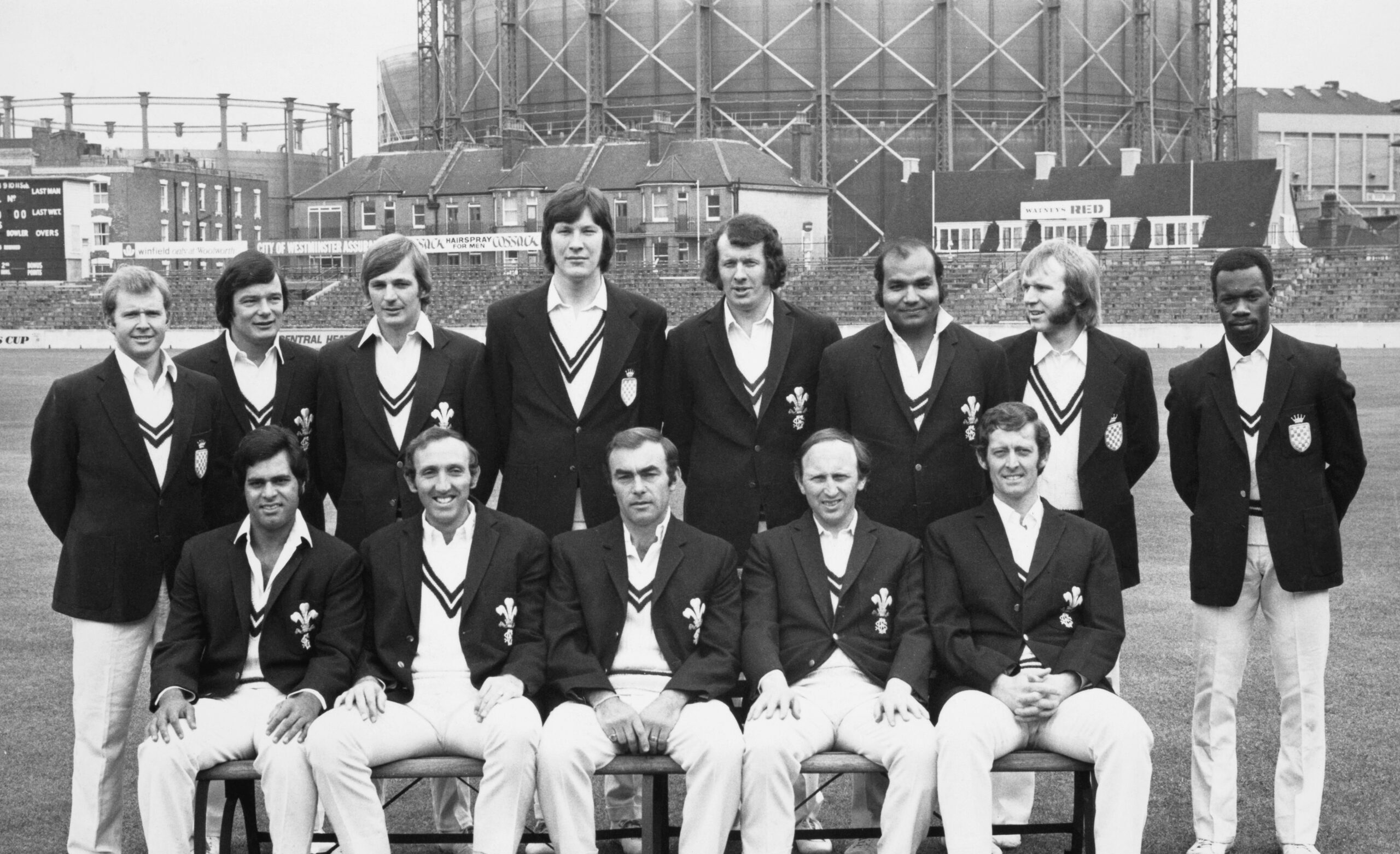
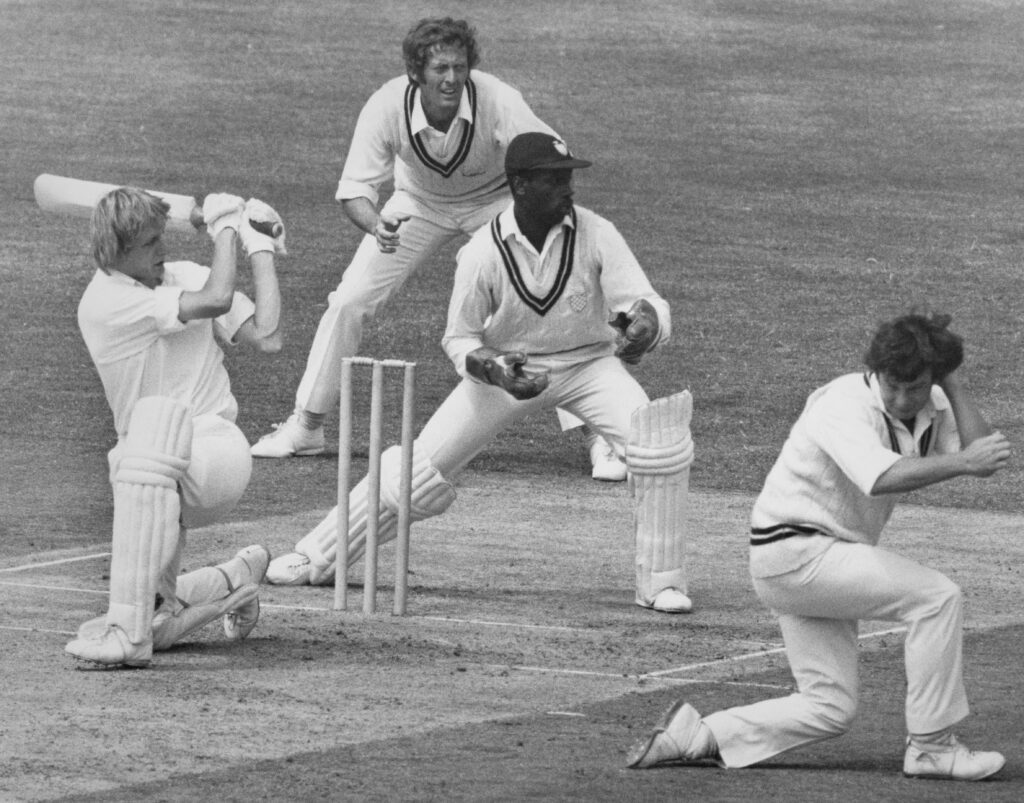
Surrey’s batting in the Championship was dominated by three players. Skipper John Edrich returned bruised and battered from an arduous Ashes campaign but remained a staunch figure for his county, making 1,050 runs at 43 and now just six short of 100 first-class centuries. Following the retirement of Mike Edwards, he had four different opening partners, including the long-haired blonde left-hander Alan Butcher.
Graham Roope’s 1,169 came at the same rate and earned him a recall for the final Test while the mercurial Younis Ahmed made 1,295 at 38.
Dropped after the first Test, Geoff Arnold’s 66 wickets at 20 underlined that he remained a constant threat, new ball partner Robin Jackman’s 72 at 24 all the more praiseworthy given he had to fill in as captain when Edrich was away at the Tests. It was a job formerly held by wicketkeeper Arnold Long but he was left out after three early limited overs matches – Lonsdale Skinner taking over – and the ever-neat gloveman left Surrey at the end of the season, heading down to Sussex where he would prove invaluable.
Spinners Pocock (59) and Intikhab (49) got through much work as usual but a third seamer was needed, Roope and Butcher sharing 33 wickets.

Men’s ODI World Cup
International limited-overs men’s cricket was less than five years old when the inaugural World Cup – sponsored by Prudential – was staged in England in 1975.
It would all be done and dusted inside 15 days, which made the weather even more important than usual, and there were nerves when snow showers reached as far south as London on June 2.
But five days later, conditions were vastly improved, leading to a baking summer which stretched into October.
There were three matches at The Oval, the first seeing Australia take on Sri Lanka – still seven years from making their bow in Test cricket – and winning by 52 runs. But after Alan Turner’s 101 – putting on 182 with opening partner Rick McCosker (73) before Greg Chappell made 50 and Doug Walters 59 – guided Australia to 328-5 from their 60 overs, it got a little feisty. Jeff Thomson’s fierce pace was well known from the previous winter’s Ashes series and now he sent two Sri Lankans to St Thomas’s Hospital.
First Duleep Mendis was forced off after being hit on the head before Sunil Wettimuny ducked into a rising delivery and then next ball – now with a runner – was smashed on the instep by a ferocious yorker, Thomson throwing down the stumps. It earned Australia few friends and the Sri Lankans, who battled to 276-4 by the end, plenty of admirers for their pluck.
The Australians were back a few days later for their clash with West Indies, which would decide the group winners.
This time Ian Chappell’s men were up against it, sliding to 61-5 and only rescued by Ross Edwards (58) and Rod Marsh (52) before being bowled out for 192 in the 54th over. Andy Roberts took 3-39.
If it looked an inadequate total, then those fears were swiftly realised by Roy Fredericks and Alvin Kallicharan putting the hitherto unconquerable Australia speed attack to the sword in a second wicket stand worth 124.
Kallicharan’s exhilarating 78 included a six and 13 fours, his mixture of cuts, drives and hooks despatching Lillee to all parts of the ground and driving the West Indies supporters – who made up much of the crowd – into a frenzy of delight.
West Indies went on to win by seven wickets with 14 overs in hand, earning themselves another day at The Oval. They were overwhelming favourites to beat New Zealand in the semi-final and did so by five wickets, the Kiwis limited to 158 all out despite Geoff Howarth making 51 on his home ground. Bernard Julien (4-27) and Vanburn Holder (3-30) were the most successful bowlers in a side where every member had played county cricket, 10 of them continuing to do so.
Gordon Greenidge (55) and Kallicharan (72) led the chase and West Indies would go on to beat Australia – victors over England in the other low-scoring semi-final – in a thrilling final at Lord’s.

Oval Test
Once the World Cup was over, a four-Test series against Australia dominated the summer.
It came on the heels of the previous winter’s 4-1 trouncing, when England were hounded to defeat by Ian Chappell’s side spearheaded by the fearsome pace duo of Lillee and Thomson. South Africa had been due originally but their isolation because of apartheid ensured it would be another decade before they returned to the international fray.
The Ashes were up for grabs again but Australia’s victory by an innings in the opening Test at Edgbaston meant recovering them was always going to be difficult. Still in charge, Mike Denness inserted the visitors despite a poor forecast later in the match and his ailing side were despatched after a thunderstorm had soaked the pitch.
Tony Greig took over the captaincy and his new England side were a rather different proposition, their captain’s desire to attack reflected in their newly aggressive attitude. They shaded a drawn match at Lord’s – Edrich making a marathon 175 in the second innings – and the third was full of absorbing cricket, reaching the end of the fourth day with Australia 220-3 needing 445.
That made England favourites, if not by much, but overnight the pitch was vandalised – holes gauged out of it and oil poured on the surface – as a stunt publicising an appeal to free George Davis from prison.
“George Davis is innocent – sorry it had to be done” read some of the graffiti nearby, all part of a campaign designed to free the man sent to jail for an armed robbery in Ilford.
The Test had to be abandoned – rain which set in at lunchtime would almost certainly have condemned it to a draw anyway – and Australia duly retained the Ashes. But with the series undecided, a sixth day was added to the Test at The Oval, just as it had been three years earlier when England led 2-1.
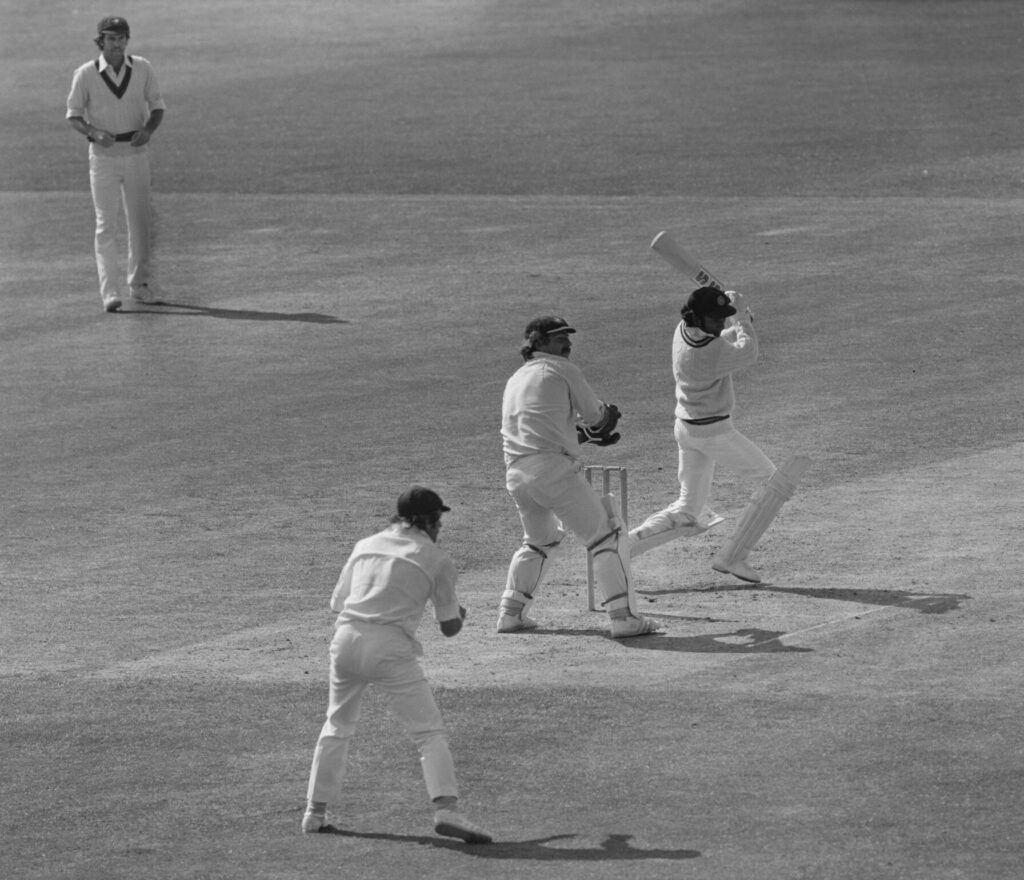
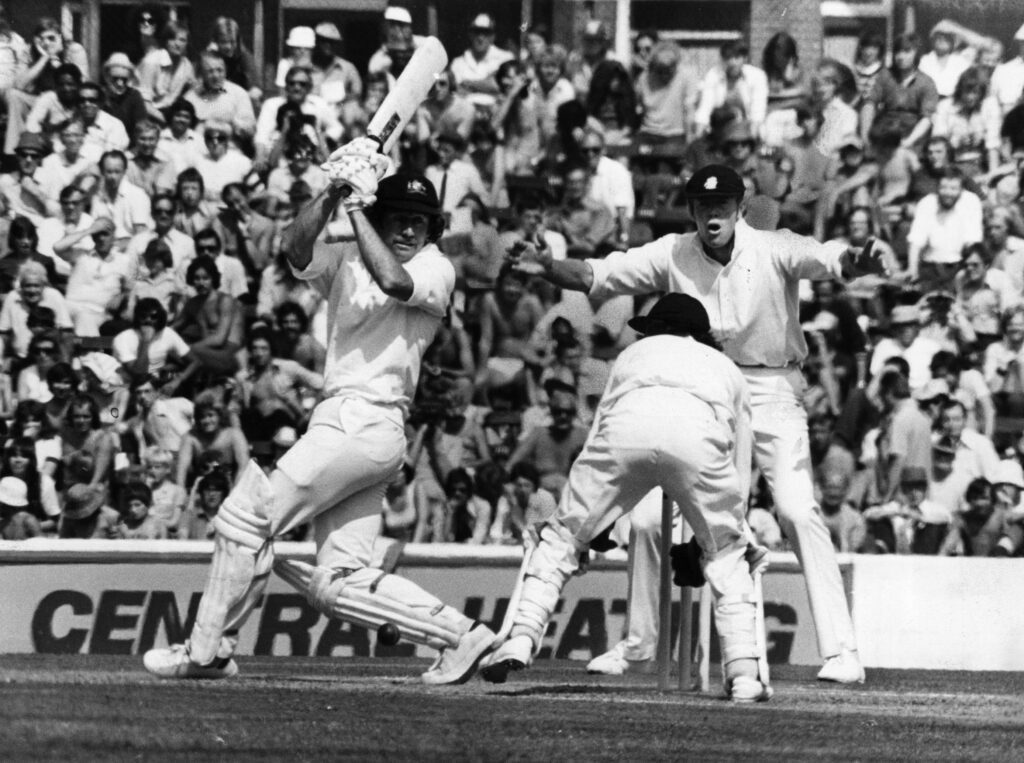
Chappell, who announced his retirement from the captaincy at the start of the final match, was in no mood to let the advantage slip after winning the toss. The tourists had lost opener Alan Turner for two but a sluggish pitch offered bowlers little and by the end of day one they were 280-1, Chappell unbeaten on 142 and Rick McCosker – who had been 95no at Headingley – completing his maiden century to be 127no.
England fought back well on day two, once the second wicket stand had reached 277, restricting Australia to 532-9dec. Greg Chappell suffering a first ball duck but Ross Edwards (44) and Doug Walters (65) extended the innings.
But after two days of continuous sunshine, a murky atmosphere – with occasional intervals for rain – made batting far more difficult on day three. Thomson, building up to full pace for just about the first time in the series, and Max Walker both claimed four wickets as England were bowled out for 191 by early on day four and another defeat beckoned, threatening to banish the Greig-inspired optimism.
An opening partnership of 77 over almost three hours between Edrich and Barry Wood (22) signalled a more determined effort second time round, the weather calm again and it was backed up as the typically staunch Edrich – the only surviving specialist batsman from the previous winter’s tour, such was the rate of attrition – was joined by David Steele. The silver-haired 33-year-old from Northamptonshire had become a cult figure since his debut at Lord’s, when he stood up to the Australian pace attack in a way few others had managed.
“The bank clerk who went to war”, as he was labelled by The Sun’s correspondent Clive Taylor, made 66 in a stand worth 125 before Edrich was bowled four short of his century. Steele went soon after but now Surrey’s Graham Roope could celebrate his recall after two years. It had gone badly at first, untypically dropping a catch and then recording a duck in the first innings. Now he made 77 and was joined by the young Kent all-rounder Bob Woolmer. England batted right through the third day – followed by the rest day – and the fourth, and the fifth, which bad light ended 65 minutes early.
Woolmer was only in his second Test, showing a studious approach and concentration which frustrated the Australians just when they thought victory was in reach.
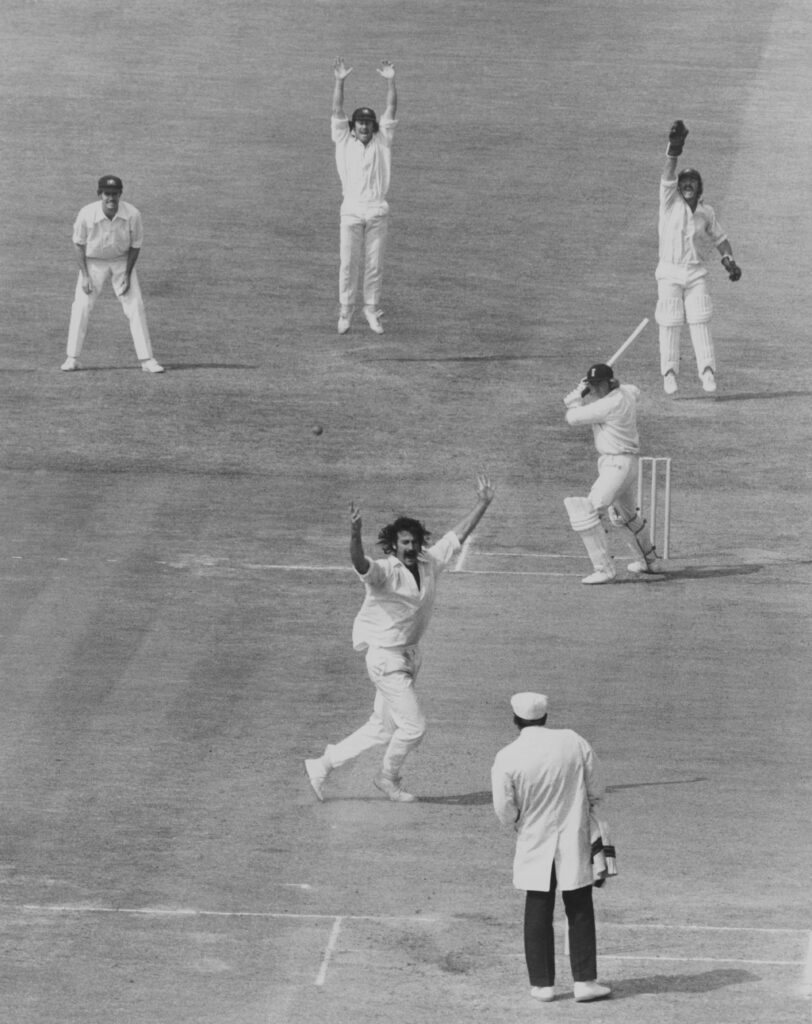
England were still in danger early on the sixth day, just 30 ahead, when Greig departed but Alan Knott joined his Kent colleague to make 64 and Woolmer’s maiden century – coming in six hours and 36 minutes, the slowest made by an Englishman against Australia – ensured safety as he went on to 149 . Lillee’s 52 overs brought him 4-91 and at one stage he resorted to bowling leg spin in protest at the surface.
Chappell may have wished he had called upon his partnership breaker Walters earlier given he finally wrapped up the innings with four quick wickets, his final victim Woolmer for 149, over 495 minutes at 538 all out. They had started bowling late on day two and finally finished after tea on day six, just having time to lose two quick wickets in their second innings before a draw was happily agreed by all concerned.
Lillee’s verdict on the pitch was shared by new Oval groundsman Harry Brind, who had arrived earlier that year and now began planning to relay the whole square.
Meanwhile, George Davis was eventually freed, the conviction ruled unsafe, and eventually exonerated, although it did him little good, being jailed again later after another armed robbery.
What else happened?
Dougal Haston and Doug Scott became the first Britons to climb Mount Everest.
Derby County, managed by Dave Mackay, won the Football League Championship for the second time in four seasons. Their former manager Brian Clough, after a disastrously short spell at Leeds United, was appointed by second division strugglers Nottingham Forest.
West Ham won the FA Cup for the second time in their history, beating Fulham in the final 2-0. Aston Villa overcame Norwich City in the League Cup final.
Manchester United, relegated 12 months earlier, were promoted back to Division One.
Leeds United reached the final of the European Cup but were beaten 2-0 by Bayern Munich and a riot by their fans cost them a one-year ban from UEFA competitions.
Wales, captained by Mervyn Davies, won rugby’s Five Nations Championship, two points ahead of Scotland, Ireland and France with England bottom.
One of the biggest upsets in Wimbledon’s history saw Arthur Ashe beat defending champion and hot favourite Jimmy Connors in four sets, the first black player to win the men’s singles.
Billie-Jean King took the women’s crown for the sixth time, hammering Evonne Goolagong Crawley 6-0 6-1.
Tom Watson won an 18-hole play-off at Carnoustie to claim the first of his five Open Championships, defeating Jack Newton by one stroke.
Undisputed world heavyweight champion Muhammad Ali retained his title in the “Thrilla at Manila”, stopping Joe Frazier in 14 rounds to avenge his defeat in the “fight of the century” four years earlier.