In 1946, as the world was recovering from six years of war, Surrey had to get their home ready for a visit from King George VI for a belated birthday party. Richard Spiller explains how it was achieved.
When Surrey marked their centenary, on August 21 1945, there was nowhere to hold the party.
Celebration was certainly in the air. Six days earlier, Japan had surrendered and the Second World War finally ended, four months after the conflict in Europe was over. But the process of rebuilding had barely begun following six years of conflict.
The Oval, having first been used to house spotter lights and anti-aircraft guns to tackle German planes raiding London, had then been transformed into a prisoner of war camp, albeit one which was never used.

A few matches around the county had been staged during WW2, mainly at colts level, and Surrey played three friendlies in August 1945, basing themselves in New Malden and then Kingston. It was estimated, though, that it might take up to three years to make their home fit for cricket.
Happily, new groundsman Bert Lock had other ideas when he was demobbed from the RAF in October but the task facing him was immense. A square full of weeds was bad enough but four huts built on concrete bases – with drains in between – large pits at the Vauxhall end and 1000 poles two feet deep in concrete, an assault course and barbed weather everywhere proved a bewildering obstacle to progress.
Given the pavilion was a complete mess and there were stands and fences in utter disrepair, Surrey launched a Centenary Appeal for £100,000 to fund the repairs, led initially by former captain Errol Holmes and then Louis Palgrave. Among the earliest donations was one from the club’s patron, King George VI.
Lock’s remarkable progress in transforming the ground back into an arena fit for cricket meant play was possible from the start of the 1946 season. His staff were boosted by men being demobbed and thus a plentiful supply of labour, even if just about everything else was rationed as Britain came to terms with being all but bankrupt.
What was then a huge outfield saw 11,000 square yards being levelled before the laying of 35,000 new turfs, selected by Lock after he had spent hours marching across the Gravesend Marshes.
If the ball did not quite race to the boundary as in the pre-war days, it was an extraordinary transformation, although parts of the ground still bore some scars of the war for many years.
A trial match was staged in April and Surrey’s return to the first-class arena, for the first time since 1939, came when they beat MCC at Lord’s by an innings and 134 runs on May 4-6. The Indian touring team formed the first opposition side at The Oval, their victory by nine wickets built on a remarkable world record set by Chandu Sarwate and Shute Banerjee as they added 249 for the 10 wickets.
County Championship cricket returned on May 18, Somerset being beaten by 10 wickets, but it was on May 23 that the real party was held.
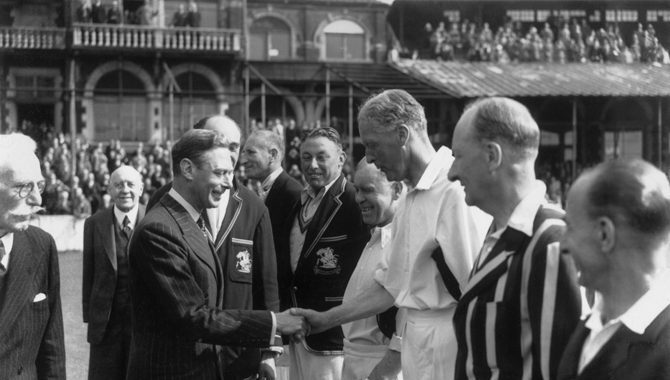
In front of a crowd of 15,000, which included the King, Surrey could finally hold their delayed 100th birthday party, taking on an Old England XI. Percy Fender captained the opposition, which included his old county colleagues Douglas Jardine, Maurice Allom and Andy Sandham, the latter opening the batting with Herbert Sutcliffe. Frank Woolley and Patsy Hendren featured in the middle order while Maurice Tate and Tich Freeman were among the bowlers and the two umpires were Jack Hobbs and Herbert Strudwick.
It was 12-a-side and the Surrey team were under instructions to let the veterans show what they could do, the hosts declaring at 248-6 and Old England gaining an honourable draw at 232-5 with Hendren making 94.
As contests went it was far from cut and thrust but it was a reminder that some sort of normality was back. There were many challenges awaiting Surrey that year – not least an average age of 36, given they were comprised of mainly pre-war veterans plus the likes of the Bedser twins – and a captain in Nigel Bennett who had been appointed by mistake and would only last one season before Holmes was reappointed for two more.
Just as Bert Lock had achieved with the playing arena, some important groundwork was being laid which would reap dividends later. Veterans such as Eddie Watts, Alf Gover, Laurie Fishlock and Bob Gregory helped the generation of the future gain vital experience. The Bedser twins, Bernie Constable and Arthur McIntyre had all made their debuts just before WW2 and now Jim Laker, Tony Lock and David Fletcher would all be given openings as Surrey built towards the glorious 1950s.