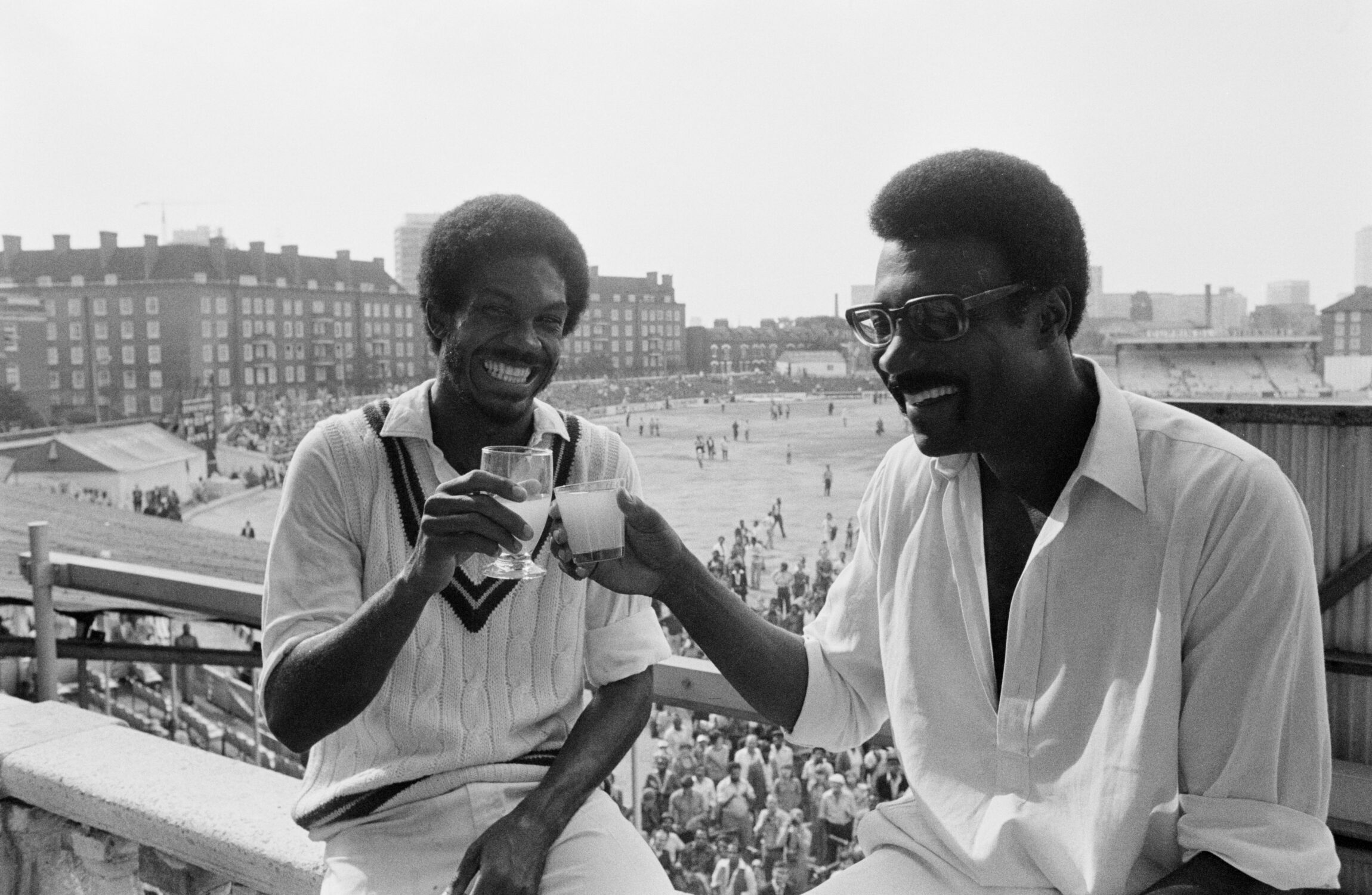
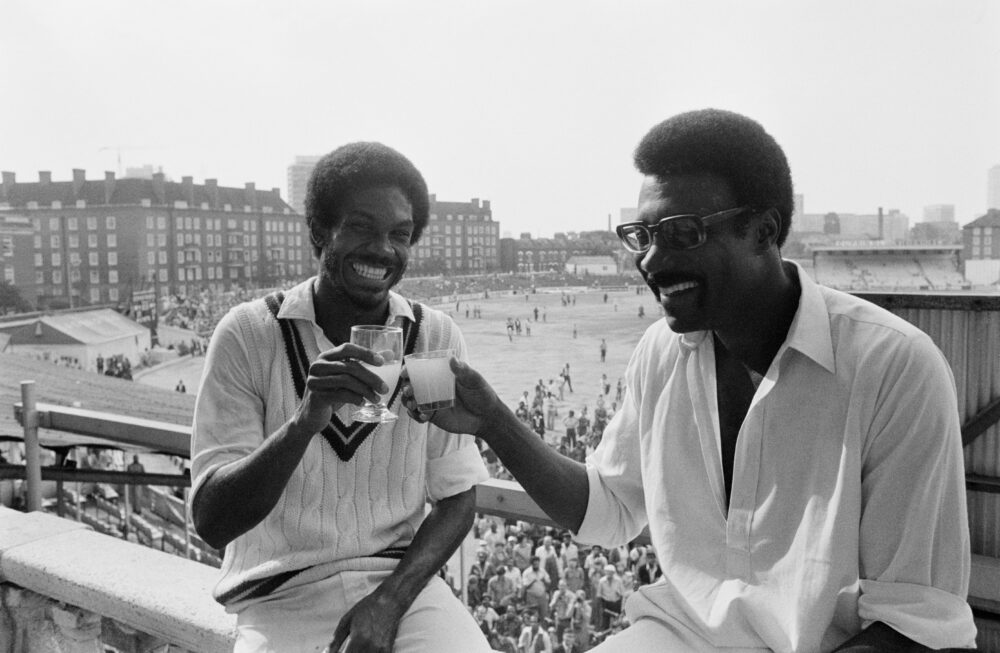
A blazing hot summer dominated by Clive Lloyd’s West Indies side – who beat England 3-0 – was altogether less satisfying for Surrey. Richard Spiller looks back half a century.
Surrey’s season
Wisden Cricketers’ Almanack admitted that Surrey had every excuse to “look back in anguish” on the 1976 season.
They achieved little on the field while off it a long-awaited ground development scheme – which had looked imminent a year earlier – fell by the wayside, caught up in red tape and the declining economic prospects affecting the country. It would not be until the 1980s that The Oval would enjoy noticeable change from the ground which had been patched up after the Second World War.
Things might have been worse. A car carrying Robin Jackman, Ray Baker and Lonsdale Skinner to a match at Worcester in June was involved in a collision. Jackman suffered bruised ribs and Baker required stitches for facial wounds.
Surrey dropped three places in the County Championship, slipping to ninth, and their decline came into even sharper focus when neighbours Middlesex secured the points they required to claim a first title since 1949 – when they had shared it with Yorkshire. Since then, Surrey had finished top nine times (one shared) but would see their northern neighbours do it six more times (one shared) before claiming back the pennant in 1999.
Playing purposeful cricket at their headquarters was not made easier given the slow nature of the pitches, head of ground staff Harry Brind having only arrived a year earlier and yet to start the renovations which would transform the playing surface to being one of the fastest in the world.
Three of Surrey’s six wins came at The Oval and another at Guildford. Their attack was weakened by spearhead Geoff Arnold, in his benefit year, missing almost half the Championship programme with a mixture of Achilles tendon and hamstring issues. That put all the more focus on Jackman, who despite his car crash finished with 80 wickets at 21 and was called up for England’s Prudential Trophy series against West Indies. Off-spinner Pat Pocock collected 57 victims and was selected for two Tests – he would have to wait another eight years for a recall – while leg-spinner Intikhab Alam took 53 but paid 39 runs each for them, the slowness of pitches disadvantaging him more than anyone.
If John Edrich’s captaincy came under the microscope, his performances with the bat still showed a fine example, making 1,248 at 44 and completing his 99th first-class century while keeping Middlesex waiting a bit longer for their glory. It was a breakthrough summer for elegant Kiwi Geoff Howarth as he stroked 1,525 at 39 while Younis Ahmed collected 1,391 at 42 and Graham Roope returned 1,033 at 38.
Taking 10th place in the John Player League – up two rungs – was another disappointment for Surrey and they went out of the Gillette Cup at the first attempt as Derbyshire won by 67 runs at Ilkeston.
The Benson & Hedges Cup, won two years earlier, was their only real sniff of achieving silverware, three wins out of four earning second place in Group D and a home quarter-final against Essex, which was won by three wickets with a ball to spare.
That brought Kent to The Oval, where former England skipper Mike Denness made 104 out of his side’s 280-3 from their 55 overs after being sent in.
Howarth (44) and the promising Chris Aworth (67) – who would quit at the end of the season – gave the hosts a good start but their middle-order fell apart against Derek Underwood (5-35) as Kent went on to win by 16 runs, beating Worcestershire in the final to maintain a fine run of one-day successes.
If Surrey’s decline had not been emphasised sufficiently on the field, it was underlined by the England party chosen to tour India that winter, no player from the club being selected for the first time since 1951-52, Wisden noting that “it was not with great regret that they closed the Hobbs gates for the last time” that season.
Edrich would captain for one more difficult year, while he attempted to make the 100th first-class century of his career and join county predecessors Tom Hayward, Jack Hobbs and Andrew Sandham in that elite club. And he would be joined by a new coach, Middlesex’s Fred Titmus crossing the river as Surrey looked outside the county for the first time in their history.
Oval Test
It was no surprise that West Indies were favourites to win the summer’s Test series. Just three years earlier they had won a mini-series 2-0 and in 1975 were the inaugural World Cup winners. But the winter had not gone smoothly for Clive Lloyd’s side, thrashed 5-1 in Australia, while India had made more than 400 to beat them at Port of Spain.
That defeat had persuaded Lloyd that he would rely on pace whatever the conditions and he now had the tools to do so in the shape of Andy Roberts, Michael Holding and youngster Wayne Daniel, backed up by Vanburn Holder and Bernard Julien.
Just in case there was insufficient incentive, England captain Tony Greig’s claim that his side would be out to make West Indies “grovel” precluded the need for Lloyd to give many team talks.
Greig’s concerns about England’s susceptibility to pace bowling led the recall of 45-year-old Brian Close, nine years after his last Test, and with John Edrich – a mere stripling at 39 – he played out a draw on the final day of the opening Test at Trent Bridge after Viv Richards had put the tourists in command by making 232 and David Steele replied with his maiden century.
The hosts gained an unexpected lead of 68 in the second Test at Lord’s as John Snow (4-68) and Derek Underwood (5-39) enjoyed a vintage Friday in another match which turned into a stalemate.
But after that it was all West Indies. Dismissed for 211 at Old Trafford, they bowled out England for just 71 before Gordon Greenidge made his second century of the match and third in successive innings, Richards – having missed Lord’s through illness – making another ton. Set a massive and impossible 552 on a pitch where the ball was lifting alarmingly for the pacers, Close and Edrich were subject to an infamous barrage of short-pitched bowling. When West Indies pitched the ball up on the fourth day, they rolled their opponents for 126 to go 1-0 up.
Changing tack in the fourth Test, England for once were able to field a fast attack of their own as Snow was joined by Bob Willis and Alan Ward, but they could not prevent Greenidge making yet another century and West Indies winning by 55 runs, despite tons in the first innings by Greig and Alan Knott.
So the teams arrived at The Oval with West Indies 2-0 up and having retained the Wisden Trophy, keen to show the large army of fans who dominated one area of the ground that they were the best team in the world.
Richards had already broken Bobby Simpson’s record of 1,381 Test runs in a calendar year and now set about going even further ahead. Injuries had cost England the services of Snow and Ward – both had played their final Test, one a great fast bowler of his time, the other an enigma who had been tipped to be among the best – but Willis trapped Greenidge LBW for a duck.
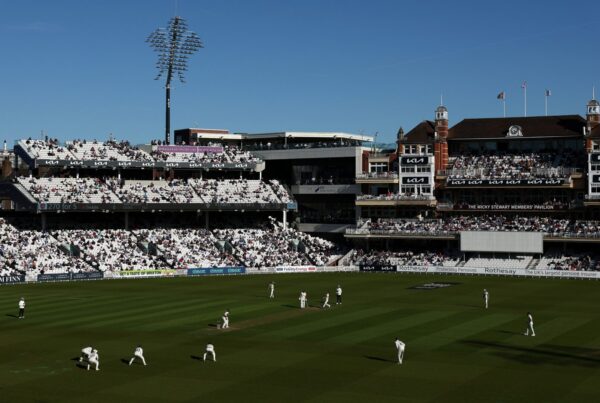
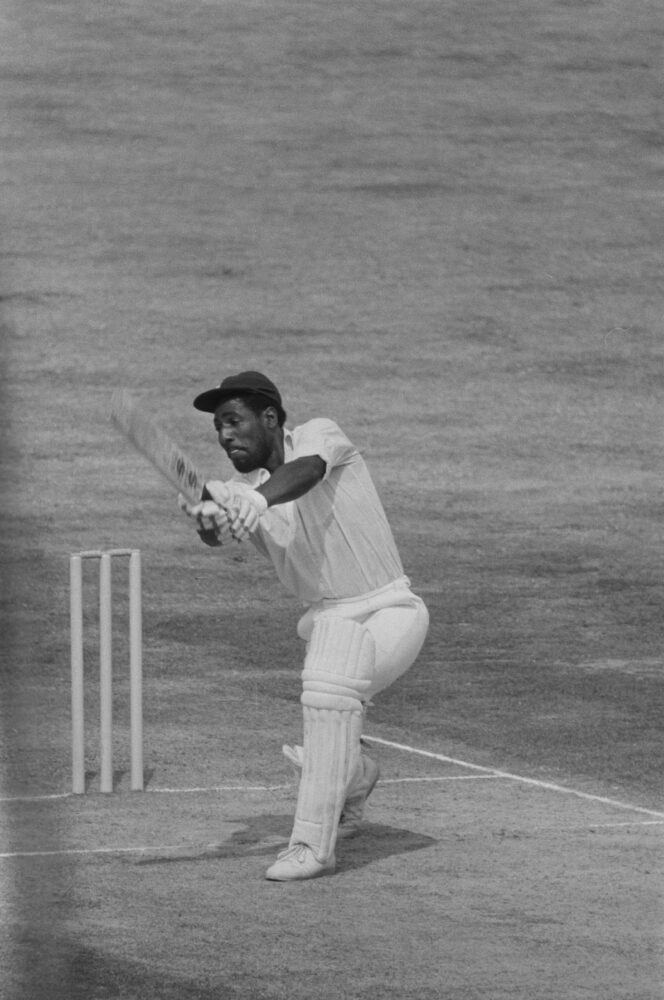
Richards strolled in and dominated the first day on a slow and easy-paced pitch, the square an oasis of green but the outfield parched. He added 155 with Roy Fredericks (155) and then dominated a third-wicket stand of 191 with Lawrence Rowe (70) to reach his second double-century of the series just before the close of day one.
Rowe had been stumped by Alan Knott for his 220th dismissal in Tests – beating the record of Godfrey Evans and appropriately off his great ally Derek Underwood – but it seemed nothing would prevent Richards going on to a triple-century and perhaps threatening Len Hutton’s ground record of 364.
But on 291, having added 141 with Lloyd, he was bowled by the persevering Greig.
West Indies were not done yet, Lloyd (84) and Collis King (63) lifting them to 687-8dec before England, who had used nine bowlers, could put their feet up.
On such a flat surface, could they be bowled out twice? The home side were into their fifth opening partnership in as many matches, Dennis Amiss having been recalled to join Bob Woolmer. With Geoffrey Boycott in self-imposed international exile, Amiss had become the focal point of England’s batting until Australian pace pair Lillee and Thomson wrecked his form and confidence while Holding had hit him on the head in a match earlier that season.
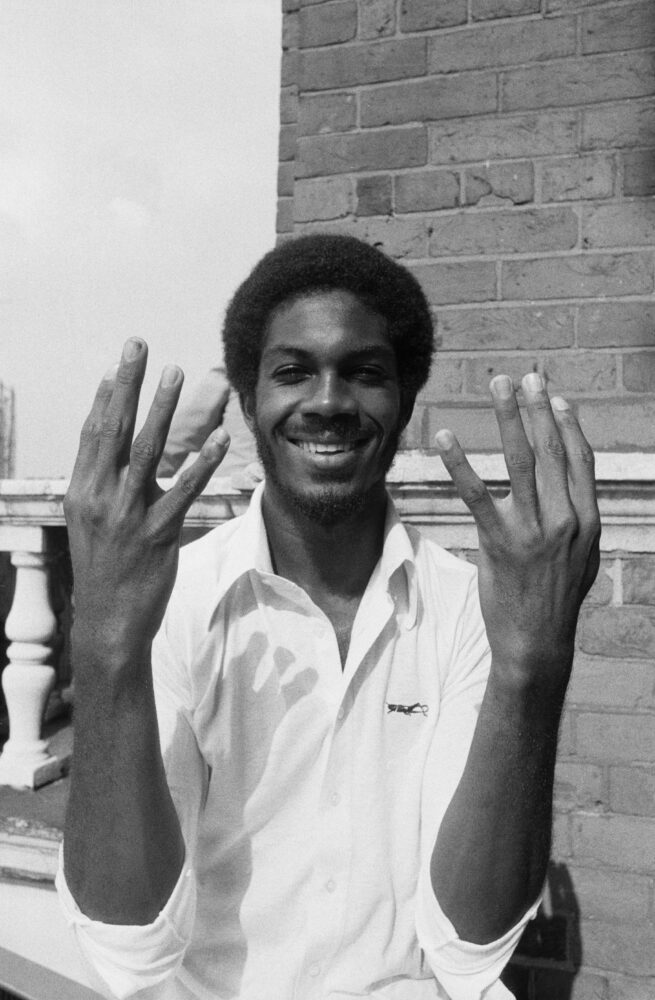
But exhibiting a new technique, with an exaggerated movement back and across, he was soon into his stride. He put on 100 for the second wicket with David Steele (44) and was enjoying conditions almost as much as Richards. The slow surface proved just as much a handicap to much of the West Indies attack – with the exception of Holding. In a performance perhaps even more remarkable than that of Richards, the pacer glided in off his long run – the reason he had been nicknamed “Whispering Death” – to work his way through the England batting.
Amiss went on to make 203 but even he fell to Holding in the end, bowled around his legs, as the Jamaican claimed 8-92 from 33 overs, Knott’s 50 and debutant Geoff Miller (36) holding him up longest, all eight either bowled or LBW.
That meant England fell short of saving the follow-on at 435 all out but Lloyd decided to rest his bowlers and a 32-over interlude on the fourth afternoon saw Fredericks (86no) and Greenidge (85no) beat the ball around the ground for 32 overs in making 182-0. Greig tried to slow them down by putting all his fielders on the boundary but it was to little effect and as he made his way off the ground the England captain humorously got down on to his knees to grovel to the West Indies supporters.
It left six hours and 20 minutes to finish the match – the target of 435 was purely theoretical – and although England were 43-0 at the close, five wickets in the first hour of the following morning all but finished the match.
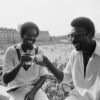
Holding castled Greig for a second time, Steele (42) and Knott (57) forming the greatest hurdles but with 80 minutes to spare Holding wrapped up the match – this time finishing with 6-57 and a staggering 14-149 overall – by trapping Willis LBW, only two of his wickets needing assistance from the field. Beaten by 231 runs, it was England’s heaviest home series defeat since 1948.
Women’s Test
It was the 50th anniversary of the Women’s Cricket Association and they celebrated it with a three-Test series against Australia, draws in the opening matches at Old Trafford and Edgbaston sending the teams to The Oval all-square and the game being extended from three days to four.
That looked unnecessary when England were bundled out for 134 on the first day and it would have been far fewer but for Lynne Thomas making 73. The tourists set about compiling a big lead, Jan Lumsden’s 133 leading them to 379 all out.
Going back in, England could only play for survival and it required an epic knock over eight hours and 41 minutes from captain Rachael Heyhoe-Flint for them to achieve it as she made 179. It meant her side made 329 all out to achieve safety in the sixth women’s Test on the ground.

What else happened in 1976?
Harold Wilson created a political sensation by retiring as Prime Minister, two years after leading Labour back to power. Winner of four elections and first in office from 1964-70, the 60-year-old admitted he was physically and mentally exhausted. He was succeeded by James Callaghan – four years older – who became the only PM to have been Chancellor, Home Secretary and Chancellor first.
He faced a relatively new Tory leader in Margaret Thatcher, who had deposed Edward Heath in 1975, and the Liberal Party also had a new frontman in David Steel following the resignation of Jeremy Thorpe.
Callaghan’s mettle was soon tested by an acute economic crisis – inflation reaching 24% at one stage – which forced the UK to borrow £2.3billion from the International Monetary Fund. Chancellor Denis Healey announced massive public spending cuts of £2.5billion as a condition of the loan.
Supersonic jet Concorde, developed jointly by Britain and France, made its first commercial flight.
The InterCity 125 train was launched into service on Britain’s railways and would remain in frontline service for 43 years.
The UK sweated through its hottest summer on record, enjoying – or suffering – 15 consecutive days of temperatures of 32c or more at one stage. Given the previous summer had also been warm, followed by a dry winter, it resulted in a draught which emptied reservoirs and led to standpipes on the streets in some parts of the country. The government was forced to introduce a law to deal with it and even appointed a minister for drought in Denis Howell. Three weeks after his appointment, the title was changed to minister for floods as nature took its course.
It was a busy year in the USA, where the bicentennial celebrations marked 200 years since the adoption of the Declaration of Independence. It was also a presidential election year, incumbent Gerald Ford – who had succeeded disgraced Richard Nixon in 1974 – losing narrowly to Democrat Jimmy Carter.
Viscount Montgomery, born opposite the Kia Oval and one of his country’s great military commanders, died aged 88. Also departing were novelist Agatha Christie and actor Sid James.
At the Winter Olympics at Innsbruck, Austria, Great Britain won a single gold medal – claimed by John Curry in the skating. The Summer Olympics in Montreal were rocked by 29 countries, many from Africa, staging a boycott in protest over the involvement of New Zealand, which maintained sporting links with apartheid-governed South Africa.
Stealing the show was Romanian gymnast Nadia Comaneci who at just 14 won three golds and achieved a perfect 10. The Soviet Union finished top of the medals table, claiming 49 golds. Britain won three, in the tornado sailing, men’s modern pentathlon and men’s 200m breaststroke, won by David Wilkie in a world record 2:145.11.
Liverpool won the Football League first division title by a point from unfancied Queens Park Rangers, their first title under Bob Paisley, quickly adding a second when they overcame Club Brugge in the Uefa Cup final.
Manchester United, having bounced back immediately from relegation, took a highly creditable third place and were hot favourites to win the FA Cup final only to be beaten 1-0 by outsiders Southampton through a goal from Bobby Stokes.
Czechoslovakia won the European Championship, staged in Yugoslavia, the winners having prevented England from qualifying. Given they had failed to reach the finals of the World Cup two years earlier, it was a big blow to the prestige of the national winter game.
Bjorn Borg, the Swede who had just turned 20, won the men’s singles title at Wimbledon as he beat mercurial Romanian Ilie Nastase 6-4 6-2 9-7. It would be the first of five successive triumphs. Australia’s Evonne Goolagong Crawley’s bid to make up for losing in the women’s singles 12 months earlier was thwarted when she lost 6-3 4-6 8-6 to Chris Evert.
The American then combined with Martina Navratilova to claim the doubles as they saw off Billie Jean King and Betty Stove 6-1 3-6 7-5.
Johnny Miller (USA) won golf’s Open Championship at Royal Birkdale, finishing six shots ahead of joint runners-up Jack Nicklaus and 19-year-old Spaniard Seve Ballesteros.
Wales swept to rugby’s Five Nations Championship in claiming the grand slam, France finishing two points behind and England picking up the wooden spoon.
Briton James Hunt won the FIA World Drivers’ Championship by a point from reigning champion Niki Lauda, who had been on the point of death after a horrifying crash in West Germany but miraculously recovered and missed just two races.