As the dying embers of the 2026 season fade away, we’re already looking forward to next summer, when the centrepiece will be The Ashes
In traditional fashion, the Kia Oval will be staging the final game of the five-match series with England hoping to recapture the urn after nearly 10 years. Joe Root’s side can be encouraged that the hosts have won more times at The Oval than any other English ground, 18 out of 39 games finishing in triumph with 14 draws and seven defeats.
Running simultaneously, the multi-format Women’s Ashes will be running with a T20 coming to Kennington on Tuesday July 6.
Richard Spiller looks back at some of England’s most famous wins between 1880 and 1953.
1880
More than three years after the inaugural Test – at Melbourne in March 1877, the first game on English soil was played. No Tests had been scheduled on the Australian tour of 1880 but the determination and enterprise of Surrey secretary Charles Alcock changed all that in a match which started on September 6.
Debutant WG Grace made 152 opening for the hosts, playing alongside his brothers EM and GF, backed up by AP Lucas (55) and skipper Lord Harris (52) in making the most of winning the toss by reaching 420 all out.
Light rain on the first evening transformed conditions, Australia being bowled out for 149 with Fred Morley taking 5-56 in 32 overs. Asked to follow-on, they were in crisis at 14-3 but captain Billy Murdoch’s 153 lifted them to 327 all out as he set a new highest Test score.
The last two wickets helped him add 140 and left England needing 57, which they might have failed to achieve but for the absence of Fred Spofforth, “The Demon” through injury, finally getting there by five wickets.
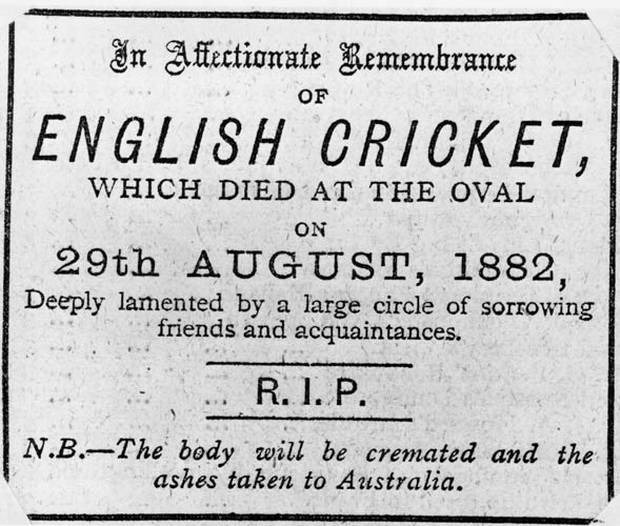
It was only when Australia returned two years later that the legend of the Ashes was spawned, the tourists winning by seven runs and a humorous notice being posted in the Sporting Times which read: “In affectionate remembrance of English cricket, which died at The Oval on August 29th August 1882.” It added that the “body will be cremated and the ashes taken to Australia.”
The urn itself came later, after England had returned the compliment.
1902
If anyone feared international cricket was a 19th century fad which would fade away, the Test of 1902 at The Oval quickly dispelled that idea.
Wet draws at Edgbaston and Lord’s had been followed by Australian wins at Sheffield’s Bramall Lane – the only Test played there – and Old Trafford, the latter by just three runs, to win the series.
A third successive defeat for England appeared to be beckoning when they slumped to 137-7 in reply to 324 and, had Bill Lockwood not been dropped, the follow-on could not have been saved. His 25 allied with George Hirst (43) pushed the home side up to 183 and then Surrey speedster Lockwood’s 5-45 led a destruction of the visitors’ second innings for 121.
Even that seemed to be in vain when, needing 263, England slid to 48-5. The start of a remarkable fightback saw Stanley Jackson – the honourable FS Jackson, to give his full title – make 49 while Gilbert Jessop carved his own niche in the game’s history, the pair adding 109 in quick time. Jessop, “The Croucher”, had promised more than he had delivered at that stage of his career but now rattled up 104 in 77 minutes, hitting 17 fours and taking an all-run five on the massive Kennington boundaries, also lasting the ball into the pavilion three times.
He finally fell at 187-7 and the hosts were still outsiders when last man Wilfred Rhodes joined his Yorkshire colleague Hirst. Legend had it that they agreed to “get them in singles” and, although history does not bear that out, they inched their way to a nerve-tingling victory by one wicket. It’s hard not to sympathise with off-spinner Hugh Trumble, who had top-scored in the Australian first innings with 64 and bowled throughout both England innings to finish with 12 wickets yet still finished on the losing side.

1926
Desperate to take their opportunity against an ageing side, England appointed a new captain in Percy Chapman at The Oval, recalled Harold Larwood – their fastest bowler – and brought back 48-year-old Wilfred Rhodes given he was enjoying a vintage summer for Yorkshire.
Just 22 runs separated the sides in the first innings but heavy rain on the second evening put England in peril, Jack Hobbs and Herbert Sutcliffe having reached stumps at 49-0 to put the hosts narrowly in front. On a pitch now treacherous, they established an alliance of 172 with Hobbs – ‘The Master’ – playing one of his most famous innings to make exactly 100 and Yorkshireman Sutcliffe going on to reach 161. That confirmed them as one of England’s great opening partnerships and put them on the way to 436.
Needing 415 to win and retain the Ashes, Australia were scattered for 125 with Larwood, later to be their scourge in the Bodyline series, claiming three wickets and Rhodes’s left-arm spin teasing the way to 4-44 to give England their first victory over their great rivals since 1912.
Celebrations, which were to be echoed in 1953 and 2005, made it a famous day for English cricket but they would not have too much to get giddy about – Australia were just about to enter the age of Bradman.
1938
Australia didn’t get it all their own way while Don Bradman was playing and he had to take second billing to Len Hutton in this match. The series had opened with draws at Trent Bridge and Lord’s followed by the Old Trafford Test being washed out without a ball bowled. In triumphing by five wickets at Headingley, Australia again retained The Ashes but the match at The Oval was once again to be played to a finish.
England had first use of another prime surface and Bradman had to watch while Hutton, at 22, batted through the first two days to be unbeaten on 300, having added 382 for the second wicket with Yorkshire colleague Leyland (187). He had Bradman’s own Test record of 334 in his sights and, on passing the record, received the adulation of the crowd and a warm handshake from the Australian captain.
Hutton went on to make 364 out of 903-7dec – which remained a team record until 1997 – as Joe Hardstaff joined in the run orgy with 169no, left-arm spinner Chuck Fleetwood-Smith suffering the mortifying figures of 1-198 from 87 overs.
Bradman had been carried off the field with a broken bone in his leg on the third day, after putting himself on to bowl, and with fellow batsman Jack Fingleton also out of action Australia sank to 201 and 123, beaten by an innings and 579 runs to leave the series drawn 1-1.
1953
Coronation year demanded sporting heroics, Queen Elizabeth II being celebrated by a number of remarkable feats.
Surrey’s Alec Bedser led the way by claiming 14 wickets in the drawn opening Test at Trent Bridge as England set out to recover the Ashes for the first time since 1934.
The post-Bradman Australians were then deprived of what had seemed a certain victory at Lord’s by Trevor Bailey and Willie Watson batting through most of the final day.
Signs that the tourists might crack – they still had a mighty attack headed by Ray Lindwall and Keith Miller – started to show at Old Trafford, taking a narrow lead on first innings but then sinking to 35-8 when they batted again only for time to run out with the fourth day having been lost.
Australia were on top again at Headingley but could not gain the success which would have retained The Ashes, which meant the fight would be settled at The Oval.
Now Bedser – who claimed a remarkable 39 wickets in the series – and Fred Trueman conspired to dismiss Australia for 275 on day one. Lindwall held them up by hitting 62 down the order and then claimed 4-70 but was unable to prevent England digging out a lead of 31 through Len Hutton’s 82 and Bailey’s 64
It was on the third day that both match and series were decided, Australia unable to cope with the Surrey spin duo of Jim Laker and Tony Lock, revelling in the helpful conditions of their home pitch to provoke a collapse from 59-1 to 85-6. Lock’s 5-45 and Laker’s 4-75 finished off the innings for 162 and England needed 132.
They lost Hutton for 17 and Peter May – the fourth Surrey player in the side – for 37 but it was appropriate that two of the bastions of England’s post-war batting were together when the moment of victory came. Bill Edrich (55no) watched as Denis Compton made the winning hit, the crowd sweeping across the ground in celebration before Hutton’s victory speech from the pavilion.